


Tristian emphasizes the need for understanding and patience from foster parents, highlighting the significance of ordinary moments in building relationships with children in care. He also discusses his memoir, ‘Against All Odds,’ which details his journey through loss, abuse, and resilience. The conversation emphasizes the need for foster parents to be more engaged and the significance of mundane experiences in a child’s life. Tristian advocates for a system that prioritizes lasting relationships and the emotional well-being of children in foster care.
Pickup a copy of his book “Against All Odds”
https://a.co/d/01AHVF7K
- Tristian entered foster care at age seven after his mother’s death.
- He experienced nearly 30 foster homes and 13 different schools.
- Abandonment and attachment issues were significant challenges for him.
- Many foster parents lacked the training to support children effectively.
- Positive experiences with foster parents can have a lasting impact.
- Academic success was achieved despite frequent school transitions.
- Foster parents should not take children’s behavior personally.
- Building rapport with children is crucial for their emotional well-being.
- Ordinary moments can create meaningful connections with foster children.
- Children in foster care often long for simple, everyday family interactions. Kids miss out on mundane experiences with families.
- It’s the little things that become the big things.
- Tristan’s memoir aims to inspire foster youth.
- Support systems need to understand their impact.
- Retention of good foster parents is essential.
- Stability and relationships are crucial for youth.
- A court order alone doesn’t provide belonging.
- Foster youth need consistent adults in their lives.
- Education is vital for children in foster care.
- Tristian’s journey highlights resilience and hope.
TRANSCRIPT:
Travis (00:00.739)
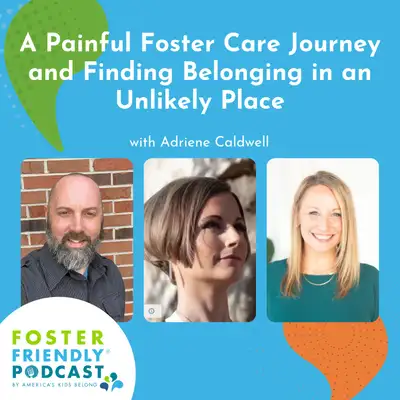
Hey, welcome to another episode of the Foster Friendly Podcast. I’m Travis Fong’s joined by my co-host Kristen Allender. And we are really excited today to have our final guest of the Aging Out series, Adrienne Caldwell. Adrian is the author of Onbroken Life Outside the Lines, a powerful memoir about surviving trauma and reclaiming hope. She’s a passionate advocate for trauma awareness and resilience. She writes and speaks to help others feel seen, supported, and empowered.
in their own healing journeys. I love that. Welcome to the podcast, Adrian.
Adriene Caldwell (00:34.033)
Thank you so much for having me, Travis. It is an honor and a privilege to be here. And thank you for providing a platform for voices like mine. So I’m very impressed with what you guys do.
Travis (00:52.089)
Appreciate that. We’re honored to have you. And we do highly value voices of of people formerly in foster care. So for sure. So before we get going a little bit more, tell us anything else you want to say more about yourself, your family, anything about
Kristin Allender (00:54.177)
Absolutely.
Adriene Caldwell (01:06.653)
Sure. So I am in Houston, Texas. I was a ward of the state of Texas. My mother did relinquish parental rights. I am married to an incredible man. My daughter is at university. She’s studying to become a teacher. Very, very proud of her. And yeah.
Kristin Allender (01:29.944)
No.
Adriene Caldwell (01:34.397)
i’ve i’ve written unbroken and i am living a life that i am so grateful for and i have such a blessed life now like the the 15 year old adrian who is in foster care would have never believed that this life would would have been possible for me so i am so grateful i am blessed
Kristin Allender (02:04.43)
That’s awesome.
Travis (02:05.559)
that. Well, before we get more into your story and hear about your journey, what is something that few people know about you? Like a strange fear, hidden talent, hobby? What what would there be something that few people might know about Adrian?
Kristin Allender (02:14.718)
Adriene Caldwell (02:22.491)
Well, I’ll share two quick things. when I was in my early twenties, I participated in a bikini bull riding contest, mechanical bull riding contest. So I I was adventurous and my top speed, I I’m I’m a Houstonian driver, you know, our it takes
Travis (02:37.635)
Gets the applause.
Kristin Allender (02:39.863)
Wow.
Kristin Allender (02:47.17)
Ha ha ha.
Adriene Caldwell (02:49.199)
an hour and a half to get from one side of Houston to the other. So we drive fast, we drive hard, we’re very aggressive. and my top speed, and I was not endangering anyone, was 159 miles per hour.
Kristin Allender (02:56.514)
Kristin Allender (03:09.019)
my goodness Where were you driving when you were doing that?
Adriene Caldwell (03:13.251)
I was on the highway, but it was barricaded by concrete barricades the entire time. So yes. And I I desperately want to do the experience where they bring like Lamborghinis and Ferraris to racetracks. And I I’m a speed demon. I I desperately want to drive a Ferrari and and see what I can do.
Kristin Allender (03:22.306)
Wow.
Travis (03:24.067)
So
Kristin Allender (03:33.111)
yeah.
Adriene Caldwell (03:42.961)
Yeah.
Kristin Allender (03:43.596)
That’s amazing. I’m glad you clarified mechanical bull too. That was the first picture that came to my mind. How long did you stay on, do you remember?
Adriene Caldwell (03:49.021)
No, no, I don’t.
Travis (03:54.967)
That takes some confidence. Bikini bull riding. I can’t.
Kristin Allender (03:56.918)
That’s awesome. I love it. I love it.
Adriene Caldwell (04:00.697)
I I’ve never been shy. and I was once awarded the the the words that my foreign exchange group chose for me was balls of steel. That’s what my moniker was, balls of steel, because I was the one who would speak up.
Kristin Allender (04:18.103)
Love it.
Adriene Caldwell (04:25.123)
on behalf of the group anytime we were displeased or needed something communicated to our teachers. So yeah.
Kristin Allender (04:34.411)
That’s awesome. Well, I’m not quite sure if the segue works about balls of steel to your foster care journey, but I’m sure, I’m sure there’s something there, right? so Adrian, I know it’s probably a a large question, but can you just give us an overview of your journey through foster care?
Travis (04:43.873)
I don’t think so.
Adriene Caldwell (04:53.981)
Certainly. My mother was schizophrenic, untreated, and physically abusive. And I I was 12 years old, I was in the sixth grade when she made the greatest sacrifice a mother can make. She knew that she couldn’t give my brother and me the kind of life or opportunities that she wanted for us. So
when she relinquished rights, it was specifically so that my brother and I would go with my best friend’s family and live with them, the Smith family. Now by that time, 13, deeply damaged from the physical abuse, the the traumas, multiple deaths in my family.
So we went to the Smith family, they had the case review, you know, the home study, they were approved, and I was damaged and they were not properly prepared for what it was gonna take to take in a damaged 13-year-old girl. And so they kept my brother and they gave me to my aunt. I was
Award of the state, but I was placed with my aunt and uncle and again 13-year-old girl with abandonment issues, severe self-worth issues, no self-esteem. And I I had when I was originally placed in foster care, they while the home study was underway, I was placed with a lovely, amazing family.
And I thought that by leaving my aunt and uncle, I would be going to a foster family like the one I had been with before. And that could not have been more opposite of the truth of what I was placed in. I was placed in therapeutic foster care. I was seen as high need because of the psychological and emotional damage that I had.
Adriene Caldwell (07:16.419)
endured and I lived with a woman that I only refer to as the witch from hell except with the B. So T B F H. That’s that’s her name in my book in Unbroken. And it was awful. And it was it wasn’t physical or sexual abuse.
Kristin Allender (07:28.171)
Mm.
Kristin Allender (07:34.541)
Mm-hmm.
Adriene Caldwell (07:44.451)
It was psychological emotional abuse. And she just very quickly, the foster girls, and she would take as many as she could get, you know, there were between four and six of us. She did not allow the foster girls to sit on the furniture. We had to sit on the floor like dogs.
We had separate food from the foster family. We had separate dishes, separate silverware. There was one full bathroom in the house, and the master bedroom had a half bath. So we were only allowed to use the toilet in the half bath, not the foster family toilet. And the last foster girl to bathe each night.
had to clean the tub with a bleach cleaner before the foster family would use the tub. So and a couple of things that she said just just to give you an idea of the severity of the abuse, I was trying on swimsuits and I came out to show her TBFH and she looked at me and said, your thighs are fat. I’m surprised you haven’t started throwing up
To lose weight. And that started, I was 15 years old. That started a battle with bulimia that continues to this day. I was diagnosed as major depressive disorder at 15, and nobody explained that your brain stops making the happy chemicals and you have to supplement.
I took it as meaning that I was defective, that I was truly damaged. And I took my razor apart and there should be trigger warnings for for this conversation. I I cut my wrists and when TBFH saw it, her response was, you didn’t even do it right. You’re supposed to cut along the vein, not across it. Yes.
Travis (09:33.592)
Mm-hmm.
Mm.
Kristin Allender (09:43.629)
Yeah.
Kristin Allender (09:57.026)
Whoa. Mm.
Travis (09:58.103)
Yeah. Hmm.
Adriene Caldwell (09:59.599)
So she was horrific. but I was so desperate to escape from her clutches that I applied and won a congressional scholarship to do a one-year foreign exchange to Germany. And so I was still awarded the state.
Kristin Allender (10:03.022)
Mm.
Travis (10:03.284)
Travis (10:20.439)
Wow.
Adriene Caldwell (10:26.819)
Everybody had to sign off on it. My caseworker, TBFH, the judge had to allow it. and I was placed with an amazing foster family in northern Germany. The weather was awful, the food was terrible. I could not have loved it more. And that was the first time that I got to really see what a healthy, functional family looks like.
Kristin Allender (10:47.831)
Mm.
Travis (10:55.897)
Mm.
Adriene Caldwell (10:56.167)
healthy communication, healthy relationships. And that that gave me kind of a a foundation, if you will, as far as as what is quote unquote normal. So it it was life-changing. And I came back from that one year foreign exchange. I went back to my aunt and uncle for a few months, then I turned 18.
Travis (11:09.539)
Sure.
Kristin Allender (11:14.008)
Mm.
Adriene Caldwell (11:25.693)
there’s a little bit of a story after that. I ended up getting my own apartment and living independently. I I was still a senior in high school, but I had my own apartment because at 18 CPS was done with me. I didn’t have the benefit of the programs that are now in place for Texas foster kids. I didn’t even have
Kristin Allender (11:50.872)
Mm.
Travis (11:53.219)
Sure.
Adriene Caldwell (11:54.799)
my driver’s license. I turned 18 with my aunt and uncle and my uncle taught me. And CPS, I so this was back early days where I had heard a rumor that CPS or the state of Texas would waive all tuition and fees if I attended a public state university.
And when I tried to talk to my caseworker about it, she knew nothing. And I had to be the one to be proactive with it and say, look, I need documentation. And basically I took the reins of my life, but I didn’t have the benefit of guidance or a plan for, you know, turning 18 and aging out. It was basically, okay, we’re done. We’re out. We did our job.
Kristin Allender (12:52.536)
Mm.
Adriene Caldwell (12:52.701)
And I made many, many mistakes. I did ultimately graduate from college in three years, technically three and a half. I had one long distance course, but three years. But I didn’t have anyone that I could turn to for guidance while I was in college. the Duke
Kristin Allender (13:01.39)
Congrats. Wow.
Mm-hmm.
Travis (13:13.271)
Hmm. Mm.
Adriene Caldwell (13:18.141)
talent identification program had identified me while I was in middle school as being gifted. So while I was with TBFH, I was actually given permission to attend a three-week summer camp where we did a year’s worth of high school work in three weeks. And that’s actually the reason I was able to graduate on time. I did it for three summers.
Kristin Allender (13:23.502)
Mm.
Kristin Allender (13:39.502)
Wow.
Adriene Caldwell (13:47.579)
They gave me a scholarship. CPS wasn’t going to cover it. But because of those classes, and I received zero credit for the classes I took in Germany, which I was very displeased because I tried so hard and and I ended up getting mostly A’s for the classes I took. So
Kristin Allender (13:55.118)
It’s amazing.
Travis (14:01.649)
bummer.
Kristin Allender (14:02.306)
Mm.
Kristin Allender (14:10.028)
Mm. Yeah. Wow.
Travis (14:10.841)
Well.
Adriene Caldwell (14:12.377)
There was so much left to be desired. And I didn’t have an adult. And my my aunt and uncle are blue-collar workers. They did not go to college. They could not help me. And the reason I brought up the Duke Talent and Identification Program is because I thought that when I was getting close to graduating college, that businesses would come
Recruit me. They would say, she’s, you know, on the dean’s list and graduating in three years. I I thought they would come to me, just like the Duke program did. And obviously that wasn’t true. Nobody told me, you know, hey, go to your guidance center in college. I was very much left to my own devices. So
Travis (14:48.025)
Mm-hmm.
Kristin Allender (15:05.592)
Well it sounds like your own devices are pretty
self advocating and resilient after being through s living through so much. one thing that well I I have lots of thoughts and questions about all that. first, I bet there’s a lot of foster parents listening who are like, she went to Germany. You know how many papers I have to get to just go across state lines right now. so I can’t even imagine. And I have questions about was that an actual like foster family in Germany? What what kind of program are they part of? So many things we can go into.
Travis (15:11.437)
Mm-hmm.
Travis (15:27.902)
Right. Yeah. Yeah. Right.
Adriene Caldwell (15:29.809)
Yes.
Kristin Allender (15:38.979)
But what I do want to focus on is I heard you use the word damaged and effective so many times. And I have to be honest, every time you said it my heart just hurt and I’m like, No, you were hurting. Like you were in pain, you were hurting. so I just want to call that out and recognize that yeah, you were you were hurting.
Adriene Caldwell (15:58.653)
Thank you. And the family in Germany was not a foster family. They were part of they volunteered to be a host family. So I was incredibly fortunate to to be placed with them. And it was night and day from the way TBFH treated me.
Kristin Allender (16:06.317)
Hmm.
Adriene Caldwell (16:28.797)
to being respected and seeing the example for for what functional and healthy looked like because I didn’t have any any examples of that. My mother was schizophrenic and physically abusive. My aunt and uncle were in no way prepared to deal for the emotional baggage that I carried.
Travis (16:31.577)
Sure.
Travis (16:43.96)
Yeah.
Kristin Allender (16:47.438)
Mm-hmm.
Travis (16:52.994)
Kristin Allender (16:53.09)
Yeah. You know, I’ll say that the importance of helping kids find belonging and that that safe, secure connections is deeply important to us as an organization. America’s Kids Belong is is obviously our our name. can you say more about some of the ways that that family in particular helped you feel like you belonged there?
Adriene Caldwell (17:17.895)
Certainly. Well, to begin with, they treated me with respect. In Germany, you’re basically an adult when you’re sixteen years old. So they they respected me, they treated me with dignity, with compassion. I was allowed they had it was so my host mother and father, they had a five-year-old daughter.
Kristin Allender (17:27.086)
Mm.
Adriene Caldwell (17:47.173)
And I was allowed to take her out. We went to the zoo. We went to the beach. I was entrusted with her. And that was polar opposite from the foster family from TBFH. So they they were just amazing. And I’m actually going to visit them in October. And I haven’t seen them in like
Travis (17:55.757)
Great word.
Travis (18:01.817)
Mm-hmm.
Kristin Allender (18:07.18)
Mm.
Travis (18:08.193)
Mm.
Travis (18:14.403)
So cool.
Kristin Allender (18:16.0)
Love it.
Adriene Caldwell (18:16.861)
twenty-five years. But I am and I am so excited because after going through what I had been through, you know, not just the abuse from my mother, the psychological and emotional abuse from my foster mother to a family the that welcomed me and embraced me. also I didn’t speak
Kristin Allender (18:18.914)
Awesome.
Kristin Allender (18:28.578)
Mm-hmm.
Travis (18:37.516)
Right.
Kristin Allender (18:41.966)
Mm-hmm.
Travis (18:44.013)
Mm.
Adriene Caldwell (18:46.359)
any German other than hi my name is and you know I could do the alphabet and count but we we spoke English for the first three weeks I was there and then my host mom said okay now we’re gonna do it in German and everything was in German from that point on and even explanations when I didn’t know a word she would explain in German so by the end
Kristin Allender (18:48.002)
Mm-hmm.
Travis (18:50.007)
Right.
Travis (18:55.289)
Mm.
Kristin Allender (18:59.213)
Okay.
Kristin Allender (19:04.298)
Blah.
Travis (19:10.699)
Kristin Allender (19:11.052)
wow. Wow.
Travis (19:14.307)
Sink or swim.
Adriene Caldwell (19:16.055)
Yes, very much so. And in Germany, high schools are tiered. So people who are going to go on to have a vocation, you know, electrical plumbing, hairdresser, what have you, they go to a certain school whereas students who are intending on going on to university go to a different high school to prepare for that. And
Kristin Allender (19:39.682)
Interesting.
Travis (19:39.981)
Mm-hmm.
Adriene Caldwell (19:43.611)
That’s the school that I went to. And in fact, when my host mom signed me up for classes, I went to the principal of the school and I said, I just finished chemistry in English in the tenth grade. I’m not doing it in German. So no. So
Travis (20:00.505)
Fair enough.
I’m like Kristen. I mean, gosh, you we have these stopping points, and you’re like, I could ask 10 things, but you know, a for sake of time here, but keeping the conversation going. But I did want to comment on it’s really fascinating too, both in a really sad but hopeful way. In both like so then your experience in this, you know, terrible foster home is adding trauma, it’s adding more damage to what you had encountered, and then you
Kristin Allender (20:14.072)
Mm-hmm.
Travis (20:34.721)
So s sad and tragic that that was and I’m sorry that that was your story there. And then you go on to what’s not a you know a foster home in Germany or, you know, truly a licensed home there. But but the hopeful thing there, even for other foster families or prospective families listening to here, is that what you were given by them was an open heart from them, it sounds like. And by them having an open heart for you, loving you, giving you a stable place, entrusting you, giving you normalcy, like there’s a lot of
Kristin Allender (20:54.328)
Mm-hmm.
Adriene Caldwell (20:55.303)
Yes.
Kristin Allender (20:58.318)
Yeah. Mm-hmm.
Travis (21:04.554)
Incredible stuff you’ll be trained on as a foster parent that we need. We’re not talking, we’re not saying training is not important. But I think the hopeful thing is some of those ingredients to just love and stability that so many families across our country possess are there. And that German example is such a great example of like what you exactly needed from a family just opening their doors for you. So yeah. I wanted to say, so you have this great line, you have a quote that you’ve said before, and I want you to respond to this. You said,
Kristin Allender (21:08.782)
Mm-hmm.
Kristin Allender (21:19.467)
Uh-huh.
Adriene Caldwell (21:24.177)
Yes.
Kristin Allender (21:25.166)
Mm-hmm. Yeah.
Travis (21:35.161)
We’re gonna shift gears a little bit here, but you said too often discussions about child welfare focus on policies and programs without fully considering how those decisions are experienced by the children, they’re meant to protect. and then so you were also hopeful in saying part of the work is seeing, in your words, where the system still has opportunities to grow. I really love that because it is a a fair critique you’re launching, but also a very hopeful place of like how to help change that. So
Can you speak more into like your thought on on that?
Adriene Caldwell (22:06.363)
Yes, absolutely. There are several initiatives that I would like to support more, one being therapy for the children in foster care. Even if that child comes to the state as somebody who’s, God forbid, their parents passed away and they have no other relatives, so they’re placed in custody.
even in that situation, that child has undergone a very traumatic event, a traumatic loss. And I believe that we can do a better job of helping kids in foster care. If I had my druthers, every child in foster care would engage in therapy of one sort or another. another opportunity.
In my case, the therapeutic foster care was outsourced to a for-profit company. They made money off of foster children. And I know that a lot of people criticize the foster families who do it for the money. I don’t if it but I do believe that if they’re going to do it as a vocation, they should be trained.
to higher standards, including understanding amount about the emotional needs, the psychological needs of children who’ve who’ve gone through trauma. Absolutely more oversight of the companies. And there is a perverse incentive just built into that system when the state outsources
To for profit companies, the foster parents and the for profit company, the higher the damage of the child, the more money they get. And on one hand, I understand that, but it creates this perverse incentive to not help the child evolve and improve. Because if a child improves,
Adriene Caldwell (24:31.389)
approves while in therapeutic care, then that means less money for the foster parent and less money for the for-profit company handling the outsourcing. There’s also there needs to be much more oversight of these programs. With me, I saw my CPS caseworker once every three or four months, if that
Basically, you know, they were done with me. I was in therapeutic foster care and I was I I to put it in perspective, my schizophrenic mother who frequently beat me, the last beating was with a closet rod, so essentially a baseball bat. I’ve never had a nightmare about my mother.
Travis (25:18.913)
Mm-hmm.
Travis (25:24.035)
Yeah.
Kristin Allender (25:24.717)
Mm.
Adriene Caldwell (25:29.957)
I’ve had nightmares about TBFH as recently as a year ago, and I wake up crying. I am still suffering from the damage that she inflicted to me, for me, on me. So and
Yes, those those are some of the things that I I believe. And there’s one other thing. I’m not sure, maybe you guys can speak to this. In the state of Texas, when you’re awarded the state until you’re 18, you can attend, as I said, any public state university and the tuition and fees are waived. And now they even have programs to help support the transition because
Travis (25:52.377)
Mm.
Adriene Caldwell (26:18.985)
I when I did this, I was responsible for my own room and board, for my own meal plan. I I had to to seek out scholarships to cover those things. And now from from the little I know, there are programs in place that facilitate that. Now there’s a a very common statistic that only 3% of foster kids go on to college.
Kristin Allender (26:24.6)
Mm.
Travis (26:40.451)
Yep. Yep.
Adriene Caldwell (26:49.167)
I’ve read more information. This the number is really around 12%. But I believe that every state should have that in place and it shouldn’t just be for university. It should apply to vocational programs as well. does do you guys know like I I
Travis (26:49.721)
Detroit.
Travis (26:55.809)
I saw that, yeah.
Travis (27:09.261)
Mm-hmm. Yep.
Adriene Caldwell (27:16.413)
Commented, I was on threads with a woman who was in foster care and I asked her if her state had waived the tuition and fees, and she said no, she had to pay for it herself. So is it common for states to have that practice or was I just incredibly fortunate?
Travis (27:18.393)
Mm-hmm.
Travis (27:34.585)
To r to reimburse tuition in in state schools. waived it.
Adriene Caldwell (27:39.335)
Well, they just waved it.
Travis (27:43.852)
It’s hard for us to generalize on state by state on that. I do think many states do have, especially at state schools in that state, opportunities where there’s either scholarship or aid directly for like and adoption as well when you’ve yeah, to cover if you’ve adopted been adopted to foster care. So yeah, but that’s that’s important funding.
Kristin Allender (27:59.683)
To cover. Mm-hmm.
Kristin Allender (28:07.244)
And and I do know that there are a lot more programs now that support that for vocational schools like cosmetology school and welding school and places where a lot of our our youth are wanting to attend that might not be suited best for a four year, you know, university experience. So yeah. Right.
Travis (28:14.903)
Yep. Yeah.
Adriene Caldwell (28:15.591)
Okay.
Adriene Caldwell (28:26.137)
Not everyone is. I am just my experience in Germany, the way they divide out, you know, peop on different paths, you know.
Travis (28:28.3)
That’s
Kristin Allender (28:32.142)
Mm-hmm. That is fascinating.
Travis (28:36.545)
Well, AI is destroying just being in college as it is anyway for anyone. But you know, I I was gonna say, like, you have some really good thoughts here, some forward thinking things. You know, one comment I would say is, you know, some of the stuff, you know, and we could all agree has probably changed, thank thank the Lord, you know, since nineteen ninety eight or I mean since the early mid nineties. That was your story. Not you know, and and some states have
Kristin Allender (28:41.73)
Mm.
Kristin Allender (29:02.338)
Mm-hmm.
Travis (29:03.935)
went for profit, then they’re not for profit, you know, continuing to try to figure out the right system. So that’s that’s really good stuff. I do want to also say that and it is commonly said by some people, you know, that, you know, there’s this sort of I would call it a myth of the there I I can agree for sure that there are f we would all agree there are bad foster parents out there. and ones that are doing it, I guess the thing around for the money
is kind of not really a it’s sort of a mythical thing in the sense that no one can do that given what what you’re getting paid having been a foster parent. It’s really to cover expenses, not income. So no one is doing this for income level money. You know what I mean? So like there there can be today, I mean there’s like certainly you can be reimbursed to help. And maybe if you’re a but yeah I think that’s a whole a a little bit on the myth side of like
Kristin Allender (29:47.086)
Mm.
Travis (29:57.963)
Again, not the reason like there’s actually wrong reasons to foster, but the sense that I think some people think the level of income people that are bad foster parents are getting, you know, to replace a career, that’s not accurate. So yeah.
Adriene Caldwell (30:13.359)
It was in my case, and again, you know, I that’s twenty years ago, but
Travis (30:17.783)
Well and and if sure, and if you have lots of or to your point, if this was a therapeutic level home and maybe in cases like that where payouts are much higher, or if you had more kids in care. But yeah, it’s anyway, that’s that’s a thing that
Kristin Allender (30:28.654)
Mm-hmm.
Adriene Caldwell (30:33.149)
I don’t think it’s inherently wrong for a foster family to do it for income purposes. I just believe that they should have better training, better understanding about what they’re getting into by taking in these kids. I don’t I don’t believe that most foster families are adequately prepared. And I would I if I had my druthers, I would make it a requirement to read firsthand.
Travis (30:47.779)
Sure.
Yeah.
Travis (30:57.677)
Yeah.
Yeah.
Adriene Caldwell (31:03.005)
accounts of life in foster care and and what these what these kids are going through.
Kristin Allender (31:03.906)
Mm-hmm.
Travis (31:04.537)
Well yeah. Well said.
Travis (31:11.767)
Yeah, that’s well said.
Kristin Allender (31:11.778)
Yeah, but they’re they’re sh they’re showing up at your door and you have no idea all that they’re coming with. And it’s gonna often turn out like behaviors and seeing beneath the behaviors, which I I am grateful that more and more states and organizations are helping bring trauma training to light and helping equip foster parents. but it’s an ongoing thing. I mean you can be trained and then you’re you’re living it and you’re like, it’s still I I need more help and support and
Travis (31:32.451)
Yeah.
Kristin Allender (31:41.272)
constantly need to be revisiting that stuff.
Adriene Caldwell (31:43.133)
Yeah, I think therapy should be absolutely mandatory. And I know that’s an a burden on the foster family, but I think our children need it and we owe it to them to to enable them to become functional citizens in society.
Travis (31:45.582)
Mm-hmm.
Kristin Allender (31:46.466)
Mm-hmm. Yeah.
Travis (31:55.437)
Yep, for sure.
Kristin Allender (31:55.693)
Uh-huh.
Travis (32:06.893)
Yep. Yep. Well said. Yeah. Yeah. Well, I mean, that’s that’s a lot of good information there. And love your heart behind your vision for seeing change and being a an important voice. So I wanted to ask you too, as we switch back to looking at foster parents, you know, as you look back at your time and care, and you’ve already kind of articulated some of this, but what if you could kind of just, you know, narrow it down to some just major big advice, like what would be kind of your biggest advice for
Kristin Allender (32:10.584)
Mm-hmm.
Travis (32:35.981)
prospective or current foster parents out there.
Adriene Caldwell (32:40.067)
read firsthand accounts. my it one of my long-term goals is to have my book incorporated into training programs. because it I I do show, I do share my my experience in foster care. I also address my my needs that were not met.
you know, the emotional, psychological needs, depression, anxiety, obsessive compulsive disorder. And I was, you know, in therapeutic care, they’re they’re given, I believe, a level of training that is more than what an average foster family would get. But I think that’s that’s a mistake. I I don’t think
Kristin Allender (33:08.984)
Mm.
Adriene Caldwell (33:36.935)
Foster parents in general are adequately prepared for the child that’s gonna walk in their door.
Kristin Allender (33:44.768)
Mm. That’s good. Well, you referenced your book and first hand experiences. tell us more about that and you can share a little bit about how you incorporated even your case file into your book. I think it’s still fascinating.
Adriene Caldwell (34:00.455)
So I included my psychological evaluation as well as the abuse diagram. I have both of those at the end of as an appendix. And each chapter I open with a quote from my psychological evaluation. And I know that I was fortunate to to have therapy.
But at the same time, I was being victimized. So on the one hand, I had certain issues that that was that were improving. On the other hand, more damage was being done. I I had a horrific experience. In fact, the my our next door neighbor, she worked in the Texas prison system for 30 years before retiring.
Travis (34:34.553)
Yeah.
Adriene Caldwell (34:58.881)
And she told police officers that TBFH treated us girls worse than how prisoners are treated. She she has that quote. So I know foster families get into it for a number of reasons. And even if it is for income, train them, expect them to.
Kristin Allender (35:09.404)
Travis (35:09.635)
Wow.
Thanks
Travis (35:21.432)
Adriene Caldwell (35:28.253)
To know or to learn how to handle these children coming into their homes, have the expectation that they are going to need help, even if they can’t verbalize it. Because to to be taken from your home, the the goal of children’s protective services isn’t to take as many kids away from from homes. It’s it’s to try to help that family.
Travis (35:39.705)
Mm-hmm.
Kristin Allender (35:53.592)
Right.
Adriene Caldwell (35:58.201)
learn how to function and what acceptable behavior techniques are. it it’s never to just, you know, gank as many kids as possible out of homes. It it’s, you know, the method of last resort. So
Travis (36:06.998)
Right.
Travis (36:11.641)
Exactly. Yep.
Kristin Allender (36:12.738)
Mm-hmm. So I imagine going through writing this book, the process of revisiting all of that, probably stirred up a lot in you. Talk about the process of writing the book.
Adriene Caldwell (36:24.079)
Absolutely. It took me five years to write. And I say that I am like expert level at compartmentalization. I say that I put each trauma in a box and it went on a metaphorical shelf behind a metaphorical door. And writing Unbroken Life Outside the Lines, it forced me to take each box out and open it up and really revisit.
Travis (36:27.917)
Wow.
Travis (36:34.553)
Mm.
Adriene Caldwell (36:54.169)
each experience and it was incredibly triggering and I include a very long trigger warning at the very beginning of my book. because for anyone who has gone through trauma, it is going to be difficult to read. My book is not easy to read and it’s not for everyone. As I mentioned before we started recording
Travis (36:55.765)
Mm.
Travis (37:15.513)
Sure.
Adriene Caldwell (37:23.409)
I’m not trying to be a best selling author. I I my goal is to have my book and possibly even my case file, my CPS case file, both used as resources in curriculum. I would like for Caldwell to be synonymous with advanced training. So that’s
Travis (37:42.169)
Mm.
Kristin Allender (37:48.248)
Yeah.
Travis (37:49.059)
Hmm. That’s
Kristin Allender (37:51.34)
I love this.
Adriene Caldwell (37:51.387)
That’s one of the reasons I I wrote to to give prospective foster families an idea of of the damage and the hurt and the pain that the child goes through. I I believe the foster families are woefully underprepared for the child that’s gonna come in and they you know.
Kristin Allender (38:02.872)
Mm, mm-hmm.
Travis (38:12.619)
Mm.
Adriene Caldwell (38:19.473)
Having therapy every other week is not going to be sufficient. It’s a start, and I believe it therapy should be available for every foster child. Again, you don’t get into foster care unless you’ve gone through horrific circumstances. But we we have to do a better job of preparing our kids for life outside of foster care.
Travis (38:25.699)
Sure.
Travis (38:34.147)
Yeah. Sure, yeah.
Kristin Allender (38:48.238)
Yeah.
Travis (38:48.696)
Yeah.
Adriene Caldwell (38:48.945)
And I’ll I’ll let you lead with your next question. I don’t wanna answer in advance. So
Kristin Allender (38:53.272)
Yeah. Hmm.
Kristin Allender (38:58.178)
Your your fine I just wanna ask follow up to that is how do you feel? So you went through the process of writing five years and now the book is out into the world. How does that feel?
Adriene Caldwell (39:09.799)
Well, I was hoping for more engagement from other foster kids. I I really want more reader engagement. Travis and I were discussing about the idea of hosting a monthly podcast where readers can come to me and ask questions. So yeah.
Kristin Allender (39:32.238)
Yeah.
Adriene Caldwell (39:37.409)
It it’s a process and it it’s going to it’s a daunting challenge the the prospect of trying to get my book incorporated into training programs, but I think it’ll be worth the effort. So
Travis (39:53.133)
Yeah. Yeah. So you’re so you’re envisioning, like you just said, like, you know, down the road and as capacity allows. Yeah. The maybe it’s a podcast we are hosting where because it’s kind of like, what do you do now? You’ve read the book or this has been your story. How do we you know, and I’ve seen some really incredible foster care alum communities that are those support groups and stuff like that. But yeah, I love that vision for you to kind of go, Okay, I’ve put this book out here. And I think being an author, I’ve written some books myself, it’s super lonely.
Kristin Allender (39:53.708)
I love it. I love it.
Travis (40:23.457)
Most of the time you don’t ever hear what your book and what the creative piece of work you did did for somebody. So I think, yeah, right. And so especially for you, I imagine like you put out your story, you’ve been so vulnerable. Right. And then on top of that, when it’s like can be sort of radio silence, you’re like, okay, I’m really exposed right now. And like, so yeah, so I can imagine some of those feelings. So yeah.
Kristin Allender (40:29.591)
Uh-huh.
Adriene Caldwell (40:29.924)
Exactly.
Kristin Allender (40:36.216)
Vulnerable, yeah.
Adriene Caldwell (40:41.906)
Yes.
Kristin Allender (40:43.843)
Mm-hmm.
Adriene Caldwell (40:48.397)
It often feels like I’m shouting into the void. You know, I’ve exposed myself. I I call it radical honesty, where I share things that don’t show me in a favorable light. I’m I am very honest and I own my mistakes and the decisions that I made. again, it it’s not casual reading.
Travis (40:51.501)
Yeah Yeah.
Kristin Allender (40:51.998)
Kristin Allender (41:15.566)
Well it’s very Yeah. No not bee tree.
Adriene Caldwell (41:18.225)
but it is ultimately a book about hope and resilience and overcoming adversity that it is possible to to go on to a future that is much brighter than than what the foster kid went through. So
Kristin Allender (41:43.49)
I love that. So as you’re as we’re closing this out, would you finish this sentence for me? What kids in foster care really need is
Travis (41:55.09)
we froze here.
Adriene Caldwell (41:55.65)
I think we’re lagging.
Travis (41:59.012)
Make it no froze.
Adriene Caldwell (42:00.367)
What what kids in foster care really need is
I can go ahead and answer what kids and okay.
Travis (42:10.029)
Let’s see if she comes back. Just give it a quick pause. You pause for a sec you kind of lagged, like she said, now you’re back. So let’s just just re maybe re ask that.
Kristin Allender (42:11.761)
am I not here? Am I not here?
Nothing happened on my end. Okay. All right. Let’s do it again. All right. Yeah. So as we close this out, would you finish this sentence for me? What kids in foster care really need is
Adriene Caldwell (42:18.597)
Okay. Well you’re back.
Adriene Caldwell (42:33.775)
An action plan for how to proceed once they age out of foster care. In Texas, there are programs for transitional living, but these kids, they many of them desperately want to be on their own. They want to be independent. They don’t want anyone telling them how to live.
And what that translates to for a a lot of foster kids aging out is couch surfing and no real direction for their life. if I if if I was in charge, if I was making the decision, no child would age out without a blueprint of where they’re at, where they want to go, and how to get there.
specifically vocationally and again whether it’s college or a vocational school regardless just having a plan and i think kids are so anxious to be on their own and be independent and not not be answerable to other people the they they they’re just so happy to be out but they don’t have
Travis (43:52.601)
Yeah.
Adriene Caldwell (44:00.849)
direction or guidance. So and if they’re not going to go to a vocational school or college, maybe they need to consider going into the military. That’s that’s another great option. So
Travis (44:03.554)
Yeah.
Kristin Allender (44:12.302)
Two Adrian, two of our other podcast guests in this series actually did go on to the military and we talked a lot about the the high rate of kids in foster care in the military and maybe tied to the need for structure and routine and all that. So it’s been a very interesting series. Can I ask you when you were in foster care, would you have desired to be adopted by a family permanently?
Travis (44:12.397)
Mm-hmm.
Adriene Caldwell (44:21.276)
Okay.
Travis (44:28.313)
Mm-hmm.
Kristin Allender (44:41.74)
Instead of aging out?
Adriene Caldwell (44:43.847)
No, no.
Kristin Allender (44:45.208)
Okay. Can you say more about that?
Adriene Caldwell (44:48.303)
I wanted my independence. I I knew that I was going to go to college. I didn’t have any guidance around that really at all. I wish I had been better prepared, but I was looking to my future. And a a quick statistic, I’m sure you guys know this, but twenty percent of the US
prison population, one in five are former foster kids. And we can do so much better. And we owe it to these children to do better.
Travis (45:20.845)
Yeah, it’s mind blowing.
Travis (45:30.733)
Yeah. Great honest answer. I I’m actually curious to ask a follow-up on that. and because I’ve I’ve seen that play out. I used to work at a group home and there was there was multiple kids who were older teenagers that just said no to to going to be it into an adoptive family. I mean and I I thought it was actually pretty cool that in those cases the courts gave them that voice. Maybe in the first time in their life they had a voice. But with that being said, of you saying, you know.
Kristin Allender (45:36.034)
Yeah.
Travis (45:58.483)
You getting into a permanent adoptive family at that time didn’t see that because of, you know, your independence and where you’re going. Do you feel though that I think you alluded to this, one of the missing pieces though was at least some major relational support while you were in college? So would that have looked like a mentoring family or kind of someone that you just maybe it was your weekend going home family or something? I mean, would that that have been a a a big important piece looking back, like just someone that?
Kristin Allender (46:19.395)
Mm.
Travis (46:26.871)
May not have been in your adoptive family, but were in some ways family. Or some yep.
Adriene Caldwell (46:31.057)
Absolutely. I I don’t know that I would have been immediately open to it. Like you would have had to have sold me on on it. But looking back, I I could have used a mentor, someone who had gone to college, someone to tell me, hey, companies aren’t gonna come look for you. You need to go to career resources and arrange that. just
Kristin Allender (46:40.11)
Mm-hmm.
Kristin Allender (46:53.772)
Hmm. Yeah.
Adriene Caldwell (47:00.861)
And when I was there, yeah, my tuition and fees were waived, but I still had to cover you know my my living. I I I didn’t I even had to pay for my own books. Now the state of Texas, there are programs now that help transition that cover dorm fees and meal plans, but
Not enough kids are taking advantage of it. And again, I don’t think every child should go to college or university. I don’t believe that. I but they do need a plan to obtain some sort of vocation. I mean, the average plumber and electrician, they’re making 80 grand a year. Whereas a kid going to college with the liberal arts degree, they’re lucky if they get 35.
Travis (47:47.265)
True. Yeah. That’s right. yeah.
Kristin Allender (47:50.792)
Mm-hmm. Right.
Travis (47:54.467)
So true. yeah, well said. So as we close this down, I just want to say, you know, regardless of where your book lands or how many, you know, people read it, I hope, you know, you more are than you know, and that people’s lives are changed or being seen that maybe you’ll never know. But you were seen today. And I want to say that just your life, your overcoming, your adversity, getting to meet you on this podcast.
Adriene Caldwell (47:54.724)
So
Kristin Allender (48:13.678)
Yeah.
Kristin Allender (48:22.592)
Mm. Absolutely. Feel the same.
Travis (48:23.201)
Really inspiring to me. And I’m sure Kristen would say the same. Yeah, what you’ve overcome and your vision to I’m always like really impressed by people that come from such a traumatic space. And some people thankfully have great experiences in foster care. And we want way more of that. But those that had wreckage in foster care, those that come back into that space and what it, you know, what it re triggers or whatever, what it can do to help bring change, those are heroic people like yourself. That is
Kristin Allender (48:52.418)
Mm-hmm.
Travis (48:52.973)
That’s courage right there. So thank you for your voice in this. And I wanted to say too, so how can listeners find you? You have a cool website, your book, you’ve given kind of a disclaimer on. How did how do people find Adrian Caldwell?
Adriene Caldwell (49:07.581)
So my website’s a great place to start, unbrokencaldwell.com. And there is a contact form. Anyone listening or who’s heard, feel free to reach out through my contact form. I read them, I respond to them. I am on Facebook, Instagram, and LinkedIn under unbroken caldwell.
Kristin Allender (49:26.03)
Right.
Adriene Caldwell (49:34.759)
So again, anyone who reaches out, I I will respond because I do, I crave the the interaction. I I want to I want to hear if my story’s helping and and how it’s impacting other people. So unbroken Caldwell.
Kristin Allender (49:47.502)
Mm-hmm.
Kristin Allender (49:56.704)
what a love it. What an honor. What an honor to get this time with you today. Thank you so much for joining us.
Adriene Caldwell (50:03.623)
Thank you for giving a platform for voices like mine. You guys are doing incredible work. So, and I hope you’re thanked for it. Thank you for what you’re doing for our kids.
Travis (50:11.769)
Thank you.
Travis (50:15.523)
Thank you.
Kristin Allender (50:17.198)
Very kind.
Travis (50:18.137)
Thanks for that encouragement.
Adriene Caldwell (50:25.932)